In the landscape of modern enterprise, risk is far more than an uncomfortable hazard—it is the catalyst for growth, innovation, and long-term sustainability. Organizations that cling strictly to safe, predictable routines often find themselves outpaced by dynamic competitors who understand how to leverage uncertainty. Beyond simple financial investments, taking calculated risks unlocks organizational potential, builds resilience, and drives sustainable business development.
1. The Core Purpose: Why Risk Is Essential for Business Development
Every enterprise begins with an act of faith. Setting up a venture, launching a product, or expanding into a new market requires leaders to venture into unmapped territory.
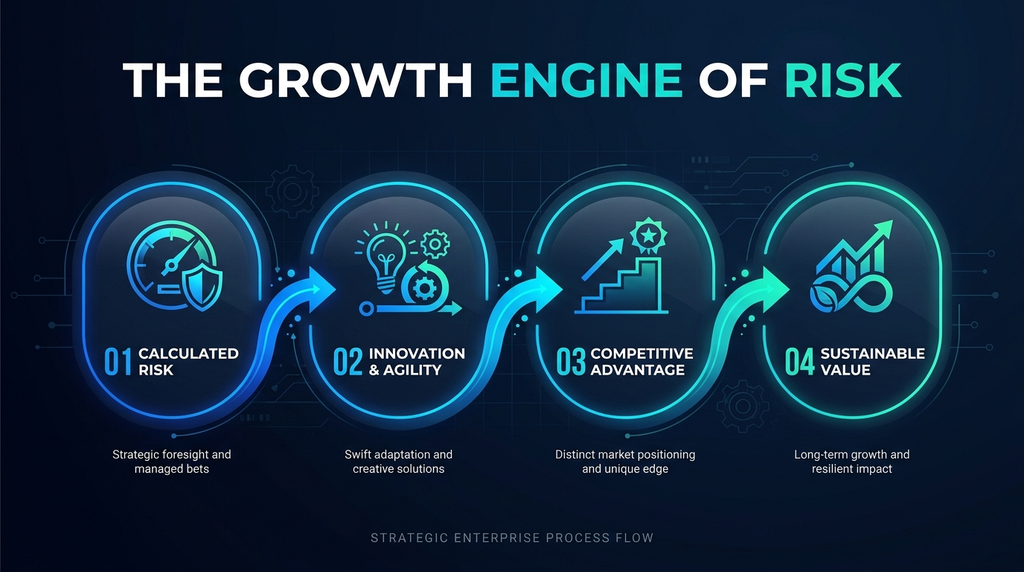
Risk management is not merely about preventing loss; it is about creating value. According to foundational insights from the Harvard Business Review on Risk Management, managing business risk effectively allows companies to identify strategic opportunities that competitors avoid. Taking intelligent risks yields several core advantages:
- Unlocking Innovation: Breakthrough solutions rarely emerge from routine operations. Real innovation requires testing unproven concepts.
- Creating Competitive Separation: Markets reward pioneers. Moving first into an emerging sector grants strong positioning before competitors enter.
- Building Dynamic Capabilities: Facing uncertain conditions forces teams to build agility, adapt processes, and develop problem-solving capabilities.
2. Navigating the Psychology of Risk: Comfort Zones vs. Growth
Understanding how individuals perceive uncertainty is key to building a healthy risk culture. A common paradox occurs in corporate leadership: executives may confidently deploy millions of corporate capital, yet act with extreme conservatism when managing personal equity.
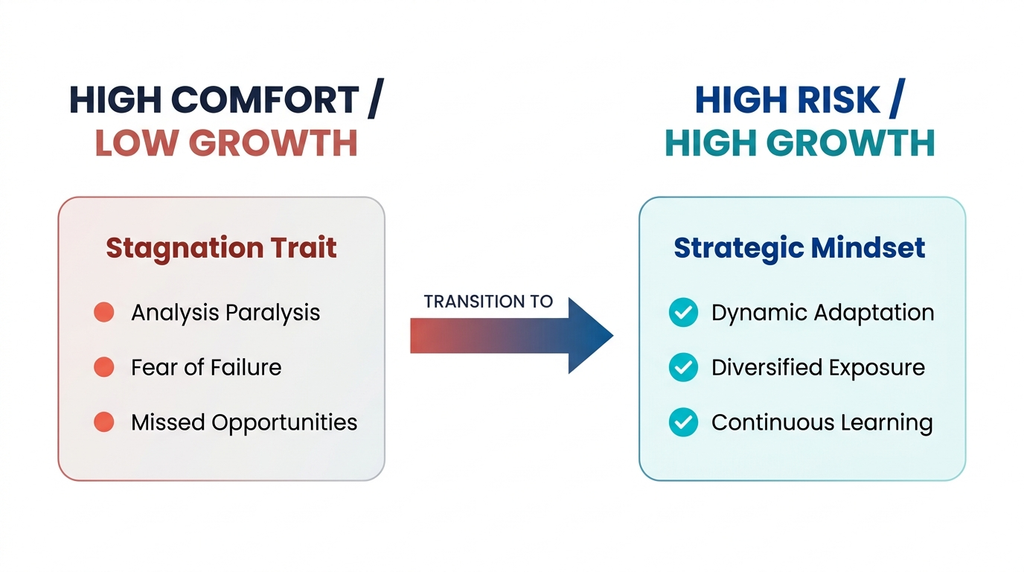
Overcoming Analysis Paralysis
The psychological barrier to taking risks usually stems from a fear of loss rather than a lack of market insight. According to behavioral research from the McKinsey & Company Insights on Risk and Strategy, organizations that build structured risk-assessment models make faster, higher-quality decisions because they decouple fear from strategic planning.
To manage psychological barriers effectively:
- Focus on Expected Value: Evaluate decisions by probability-weighted outcomes rather than binary success/failure mindsets.
- Reframe Mistakes as Data: Early, small-scale missteps provide essential operational feedback before major capital deployment.
- Establish Clear Boundaries: Define explicitly how much downside the company can absorb without compromising stability.
3. Practical Frameworks for Risk Optimization & Safety
Taking risks does not mean operating recklessly. High-performing companies utilize structured frameworks to ensure that downside exposure remains capped while upside potential remains open-ended.
Core Principles of Safe Risk Execution
- Portfolio Diversification: Never commit all capital or resources to a single initiative. Distribute investments across multiple complementary projects.
- Asymmetric Risk-Reward: Target opportunities where the maximum potential loss is small and fixed, but the potential upside is significantly larger.
- Early Testing & Iteration: Validate concepts with Minimal Viable Products (MVPs) before scaling operations or expanding capital expenditure.
4. Methodological Comparison: How Leading Frameworks Address Risk
Different corporate frameworks handle uncertainty in distinct ways. The table below compares four widely used strategic planning models:
| Framework / Approach | Primary Focus | Best Used For | Key Advantage | Main Limitation |
| Enterprise Risk Management (ERM) | Comprehensive risk identification, governance, and compliance. | Large enterprises and regulated industries. | Systematic protection across all operational units. | Can slow down speed-to-market if over-bureaucratized. |
| Agile & Lean Frameworks | Rapid iteration, small bets, and continuous validation. | Product development and tech startups. | Limits financial downside through short release cycles. | Harder to apply to massive infrastructure investments. |
| Scenario Planning | Stress-testing strategies against multiple potential futures. | Long-term capital allocation and expansion. | Prepares leadership for macroeconomic volatility. | Requires significant analytical resources and foresight. |
| Real Options Valuation | Flexible capital deployment based on milestone achievements. | Venture capital and R&D pipelines. | Preserves operational flexibility while capping downside. | Complex to model accurately in unpredictable markets. |
For authoritative guidance on implementing formal governance structures, review the ISO 31000 Risk Management Standards established by the International Organization for Standardization.
5. Strategic Comparison of Investment Risk Profiles
When allocating financial resources or operational capital, businesses must balance risk levels against expected returns.
| Asset / Strategy Type | Expected Volatility | Risk Exposure | Downside Protection | Strategic Role in Business |
| Core Cash & Treasury Reserves | Very Low | Low | Maximum | Preserves liquidity and operational safety net. |
| Established Market Expansion | Moderate | Moderate | High | Delivers reliable incremental revenue growth. |
| New Product / R&D Ventures | High | Elevated | Moderate | Unlocks potential market breakthroughs and new revenue. |
| Disruptive Innovation / M&A | Very High | Significant | Low | Positions the organization for market leadership. |
6. Overcoming the Fear of Failure: Building Organizational Endurance
The ultimate differentiator between thriving companies and stagnant ones is how they respond to unexpected setbacks.
“A sailboat in a harbor is safe, but that is not what ships are built for.”
In business, total safety is an illusion. Remaining passive in a changing market guarantees eventual decline as technological shifts, regulatory changes, and evolving buyer preferences alter the competitive landscape.
Steps to Build a Risk-Tolerant Culture
- Decouple Failure from Punishment: Encourage calculated initiatives so teams do not hide emerging problems or avoid ambitious goals.
- Conduct Post-Mortems: Treat unsuccessful ventures as source material for strategic improvement rather than administrative failures.
- Reward Intelligent Initiative: Recognize teams that take well-researched, strategic risks regardless of whether the outcome was an immediate commercial success.
Taking calculated risks is not about gambling with corporate resources it is about creating an engine for continuous adaptation and long-term development. By establishing clear risk limits, diversifying investments, and adopting modern execution frameworks, companies can move forward with confidence, turn market volatility into strategic opportunity, and secure sustainable success.